Search no longer works the way it used to.
For years, businesses focused on one main goal: ranking higher in Google. The objective was clear — reach the top positions, increase organic traffic, and turn visitors into leads.
In 2026, this is no longer enough.
Google is actively developing AI Mode and AI Overviews — search experiences where users receive AI-generated answers instead of simply browsing through a list of links. These answers can summarize information, compare options, explain complex topics, and suggest the most relevant sources.
For businesses, this changes the entire logic of digital visibility.
Previously, the goal was to appear in search results.
Now, the goal is to become a source that artificial intelligence trusts enough to include in its answer.
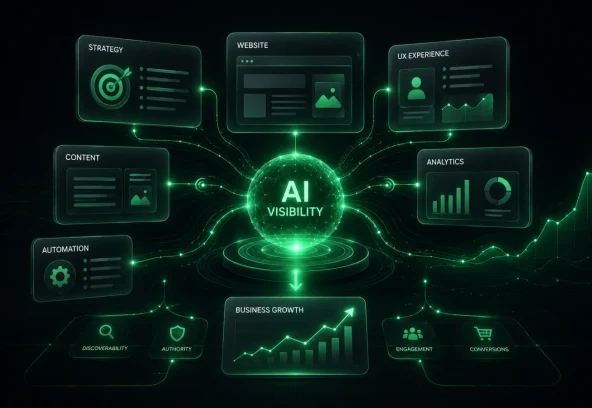
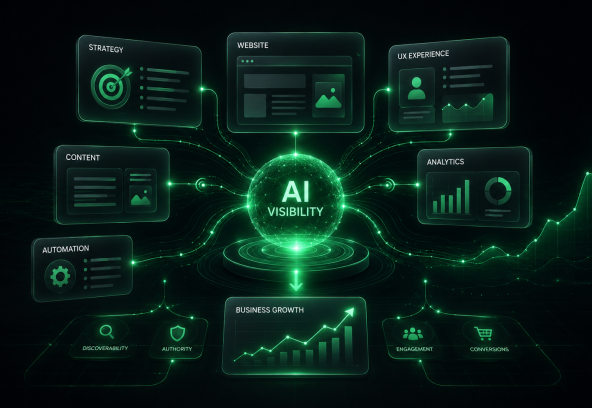
This means SEO can no longer be treated as a separate technical task. It must work together with content, branding, website structure, UX, analytics, and the overall digital strategy of the business.
What Has Changed in Google Search
Traditional search worked in a simple way.
A user typed a query, saw a list of websites, compared the results, clicked on one of them, and made a decision.
AI-powered search changes this journey.
Now the user may ask a more complex question and receive a ready-made answer directly in the search interface. That answer may include explanations, recommendations, summaries, comparisons, and links to selected sources.
The new journey often looks like this:
- The user asks a complex question.
- Google generates an AI-powered answer.
- The system gathers information from several sources.
- The user receives a short explanation or recommendation.
- Only after that does the user decide which website to visit.
In other words, your website is no longer competing only for a blue link in Google.
It is competing for the right to become part of the AI-generated answer.
Why Traditional SEO Is No Longer Enough
Traditional SEO still matters.
Technical optimization, indexing, page speed, internal linking, meta titles, structured content, and search intent are still important. AI-powered search is built on top of the search ecosystem, not outside of it.
But the problem is that many businesses still treat SEO as a checklist:
- add keywords;
- write several articles;
- optimize title tags;
- add meta descriptions;
- build a few backlinks;
- publish FAQs;
- wait for rankings to grow.
That approach is too weak for the new search environment.
AI systems do not simply look for a keyword on a page. They analyze whether the content actually helps the user, whether the structure is clear, whether the information is trustworthy, and whether the website can be used as a reliable source.
That is why businesses need to move from “SEO texts” to expert content.
The future of SEO is not about writing more generic articles.
It is about building a digital knowledge system around your brand.
What Is GEO?
GEO stands for Generative Engine Optimization.
It means optimizing your website and content so that generative AI systems can understand, trust, and potentially use your content in their answers.
GEO is relevant for platforms and systems such as:
- Google AI Overviews;
- Google AI Mode;
- ChatGPT Search;
- Gemini;
- Perplexity;
- Copilot;
- Claude;
- other AI assistants and LLM-based search systems.
However, GEO does not replace SEO.
It expands it.
Classic SEO helps your website become visible in search engines. GEO helps your content become understandable, trustworthy, and useful for AI-generated answers.
The strongest results come when SEO and GEO work together.
How AI Chooses Sources
There is no public formula that guarantees your website will appear in AI answers.
Any agency that promises “100% visibility in ChatGPT, Gemini, or Google AI” is not being honest.
But there are clear principles that increase your chances.
AI systems are more likely to use content that is:
- clear;
- structured;
- specific;
- expert-driven;
- regularly updated;
- connected to related topics;
- supported by examples, data, or cases;
- easy to understand;
- useful for the user’s real question.
This means one article should not only answer the main keyword.
It should cover the surrounding questions as well.
For example, if a user asks:
“How should a business prepare its website for Google AI Mode?”
AI may also look for information about:
- what Google AI Mode is;
- how AI Overviews work;
- how to optimize a website for AI Search;
- whether SEO strategy needs to change;
- how expert content should be structured;
- whether UX affects AI visibility;
- how to measure performance in AI-powered search.
If your website answers these related questions better than your competitors, it has a stronger chance of becoming a useful source.
Why a Website Is No Longer Just a Website
In 2026, a company website is not just an online business card.
It is a complete digital asset.
It works as:
- a trust-building platform;
- a source of information for customers;
- a knowledge source for search engines;
- a potential source for AI models;
- a sales tool;
- a brand perception tool;
- part of the performance marketing funnel;
- a data and analytics hub.
If your website looks outdated, lacks structure, does not explain your value, or contains only generic marketing phrases, your advertising budget will work less efficiently.
You can drive thousands of visitors from Google Ads, Meta Ads, SEO, or social media, but if users do not understand why they should trust your company, your conversion rate will remain low.
AI Search makes this even more important.
Artificial intelligence is more likely to rely on sources that provide clear, structured, and useful answers. A website filled with vague phrases such as “individual approach,” “high quality,” and “professional team” will lose to a website that provides real expertise, cases, numbers, explanations, and a clear point of view.
What Businesses Should Do Now
1. Stop Writing SEO Texts Just for SEO
The old approach of writing long keyword-heavy articles is no longer a strong strategy.
Content needs to answer real customer questions.
Weak example:
“Our company provides high-quality digital marketing services for businesses.”
Strong example:
“How to tell if your business is losing leads because of a weak website structure: 7 signs you can identify before launching ads.”
The second version is much stronger.
It is specific.
It solves a real problem.
It can rank for search queries.
It can be useful for AI-generated answers.
It can support internal linking.
It can move a potential client closer to conversion.
This is the type of content businesses need in 2026.
2. Build an Expert Topic Map
To grow in Google and AI Search, one article is not enough.
You need a content system.
For example, a digital agency can build content clusters around topics such as:
- SEO in the age of AI Search;
- GEO and LLM optimization;
- performance marketing;
- websites as sales systems;
- CRM and analytics;
- brand positioning;
- content strategy;
- sales funnels;
- marketing for real estate;
- marketing for hotels;
- marketing for premium brands;
- digital automation.
Each article should support the others.
Together, they turn the website into an AI-ready knowledge hub — a structured base of expertise that can be understood by users, search engines, and AI models.
3. Work With Entities, Not Just Keywords
Modern search understands not only keywords, but also relationships between concepts.
For an article about AI SEO, the important terms are not only “SEO 2026” or “Google AI Mode.”
The surrounding entities also matter:
- AI Overviews;
- Generative Engine Optimization;
- Answer Engine Optimization;
- Search Console;
- structured data;
- E-E-A-T;
- crawlability;
- indexing;
- helpful content;
- user intent;
- conversion rate;
- UX;
- CRM;
- analytics;
- content strategy.
When your website consistently covers these connected topics, search engines and AI systems can understand your expertise more clearly.
This is one of the key differences between old SEO and modern AI Search Optimization.
4. Strengthen the Technical Foundation
Even strong content will struggle if the technical base is weak.
At a minimum, your website should have:
- fast loading speed;
- proper indexing;
- no blocked important pages;
- strong mobile usability;
- logical H1–H3 structure;
- optimized title tags and meta descriptions;
- clean internal linking;
- correct canonical settings;
- Google Search Console setup;
- analytics connected to real business goals;
- structured data where appropriate.
Technical SEO does not guarantee AI visibility.
But without it, your chances become much lower.
A technically weak website is harder to crawl, harder to understand, and harder to trust.
5. Add Expertise and Proof
AI-powered search does not reward empty promises.
A strong page should include:
- real experience;
- case studies;
- numbers;
- comparisons;
- methodology;
- examples;
- FAQs;
- expert opinion;
- updates;
- sources;
- clear authorship or brand responsibility.
This is especially important for service businesses.
If your company writes about marketing but does not show how it thinks, how it builds systems, how it analyzes problems, and how it makes decisions, the content will feel weak — both for humans and AI.
The goal is not simply to publish content.
The goal is to prove expertise.
The Biggest Mistake: Looking for an AI Hack
Many businesses are now searching for quick ways to appear in AI answers.
They try to:
- create AI-specific files;
- generate hundreds of low-quality articles;
- mass-produce FAQ sections;
- add more keywords;
- buy mentions;
- create pages for every possible search phrase.
This is not a long-term strategy.
The future of SEO is not based on hacks.
It is based on a strong digital system:
- clear positioning;
- a useful website;
- expert content;
- technical SEO;
- trust signals;
- analytics;
- regular optimization.
Businesses that understand this will have a major advantage.
Businesses that continue publishing generic content will become less visible.
How to Measure Results
In the past, businesses mostly looked at rankings, traffic, and leads.
These metrics are still important.
But in the AI Search era, businesses also need to track a broader set of signals:
- organic impressions;
- branded searches;
- growth of expert-topic visibility;
- conversion from organic traffic;
- appearance in AI-generated answers;
- brand mentions;
- direct traffic growth;
- lead quality;
- content-assisted conversions;
- influence of content on sales.
AI visibility is becoming a separate layer of digital performance.
It is no longer enough to ask:
“Are we ranking in Google?”
The better question is:
“Are we becoming a trusted source in our category?”
What an AI-Ready Website Should Include
An AI-ready website should be built as a digital growth system.
Clear Structure
Users and search engines should quickly understand:
- who you are;
- what you do;
- who you help;
- what problem you solve;
- why your company can be trusted;
- what results you have achieved;
- how to contact you.
Expert Content
Your website should include more than service pages.
It should also have:
- guides;
- insights;
- case studies;
- comparisons;
- FAQs;
- checklists;
- opinion articles;
- articles based on specific customer pain points.
Trust Signals
A strong website needs proof:
- portfolio;
- case studies;
- numbers;
- testimonials;
- process explanation;
- team expertise;
- methodology;
- clear communication.
Analytics
Without analytics, it is impossible to understand what works.
You need to know:
- where users come from;
- which pages generate leads;
- where users drop off;
- which topics attract qualified traffic;
- which channels influence sales.
How MOVEON Approaches SEO and AI Search Optimization
At MOVEON, we do not treat SEO as a separate technical service.
SEO, GEO, and LLM optimization should be part of the full digital growth system.
We look at every project through several layers.
1. Strategy
First, we analyze the business model, target audience, geography, product, competitors, and real growth opportunities.
Without strategy, SEO becomes a random set of articles.
2. Positioning
If a brand cannot clearly explain its value, traffic will not convert into leads.
That is why we work not only with keywords, but also with meaning:
- why should a client choose you;
- how are you different;
- what problem do you solve;
- what result do you create;
- what proof can you show.
3. Website and UX
A website should not only look good.
It should guide the user toward action:
- understand the service;
- see the value;
- trust the company;
- explore cases;
- submit a request.
4. Content System
We build content in clusters, not isolated posts.
Each article should support another article, and the whole blog should strengthen the brand’s expert field.
5. Technical Optimization
We check indexing, speed, page structure, metadata, internal linking, schema markup, analytics, and Search Console setup.
6. Analytics and Growth
Publishing content is only the beginning.
After publication, we analyze which topics grow, which pages receive impressions, where there is potential for improvement, and which materials should be updated or expanded.
Checklist: Is Your Website Ready for AI Search?
Use this checklist to evaluate your current website:
- Is it clear what your company does within the first few seconds?
- Do you have expert articles, not only service pages?
- Does your content answer real customer questions?
- Do you show cases, numbers, or proof?
- Are your important pages indexed?
- Is your mobile version convenient?
- Does your website load quickly?
- Do your service pages, cases, and blog articles link to each other?
- Do you use Google Search Console and analytics?
- Do you update your content regularly?
- Do key pages include FAQ sections?
- Is your H1–H3 structure logical?
- Does your content include expert opinion?
- Could your pages be used as a source for an AI answer?
- Does your website help generate leads, or does it simply exist?
If the answer to most of these questions is “no,” your website is not ready for the new search reality.
Why Businesses Should Start Now
AI Search is developing quickly.
Companies that start building their expert knowledge base now will gain an advantage before the market becomes more competitive.
Trust in search does not appear overnight.
Google and AI systems need to see that your website regularly publishes useful content, covers topics deeply, has a clear structure, and provides real value to users.
The earlier a business starts building an SEO and GEO system, the stronger its position can become in the future.
Conclusion
Google AI Mode, AI Overviews, and other AI-powered search systems are changing the rules of digital marketing.
But this does not mean SEO is dead.
It means SEO is becoming deeper.
The winners will not be companies that simply add more keywords.
The winners will be companies that build a complete digital system:
- strong positioning;
- a clear website;
- expert content;
- technical SEO;
- analytics;
- trust;
- continuous optimization.
In 2026, SEO is no longer just about promoting a website.
It is about building a source that people, Google, and artificial intelligence can trust.
FAQ
What is Google AI Mode?
Google AI Mode is an AI-powered search experience that allows users to ask complex questions and receive expanded AI-generated answers with links to useful sources.
What are AI Overviews?
AI Overviews are AI-generated summaries in Google Search that help users quickly understand complex topics and explore relevant sources.
Is SEO dead because of artificial intelligence?
No. SEO is not dead. It is evolving. Technical SEO, search intent, indexing, website structure, and quality content are still important, but expert content and trust are becoming even more valuable.
What is GEO?
GEO, or Generative Engine Optimization, is the process of optimizing websites and content for generative AI systems and AI-powered search experiences. It complements traditional SEO.
Can a business guarantee visibility in ChatGPT, Gemini, or Google AI?
No. No one can honestly guarantee 100% visibility in AI-generated answers. However, a business can increase its chances by improving technical SEO, publishing expert content, building authority, and creating a clear digital structure.
What matters more for AI Search: keywords or expertise?
Both matter, but keywords alone are not enough. AI Search is more likely to use content that provides clear, structured, useful, and expert-level answers.
How should a business start optimizing for AI Search?
Start with a full website audit. Check technical SEO, page structure, content quality, analytics, positioning, and how well your website answers customer questions. Then build a content system around your main expertise.
Want to know if your website is ready for Google AI Mode, AI Overviews, and the new era of search?
MOVEON can audit your digital system — including your website, content, SEO, analytics, funnel, and growth opportunities.
We will show where your business is losing visibility, trust, and leads — and how to turn your website into a source of growth.
Contact MOVEON to get a strategic view of your digital marketing.